
The following article is compiled from research conducted throughout 2024 and 2025 by the University of Miami’s Community Ownership Learning and Action Lab. It complements our field note (a visual summary of the research), called “Holding Space: How Investment Cooperatives Are Anchoring Stability in the Twin Cities.” The COLA Lab’s research is formally published in our case study series, Community Ownership Field Guide: A Multi-City Panorama.
For over a century, racialized real estate policy — from racial covenants to concentrated disinvestment — extracted wealth from Black, Latino, and immigrant communities in the Twin Cities. The legacy is measurable: more than $1 billion in residential assessed value has transferred to outside investors since 2005, while homes in predominantly Black neighborhoods remain valued over 20% lower than comparable homes in white neighborhoods.
Since the 2010s, commercial gentrification has displaced small, minority-owned businesses and weakened key neighborhood institutions. More recently, post-pandemic destabilization, the civil unrest following the murder of George Floyd, and 2026 federal immigration crackdowns have accelerated pressures on small businesses.
In response, residents and small business owners are forming real estate investment cooperatives (REICs) — pooling capital to acquire commercial and mixed‑use properties, often before speculators. REICs (also called community investment cooperatives) blend cooperative governance with investment structures to democratize ownership and fund mission‑driven real estate as an alternative to speculative ownership. Today in the Twin Cities, community ownership of commercial real estate outpaces most U.S. regions.
This study centers on three projects:
Ignite Business Women Investment Group (IBWIG) in partnership with African Career, Education & Resource, Inc. (ACER) in Brooklyn Center;
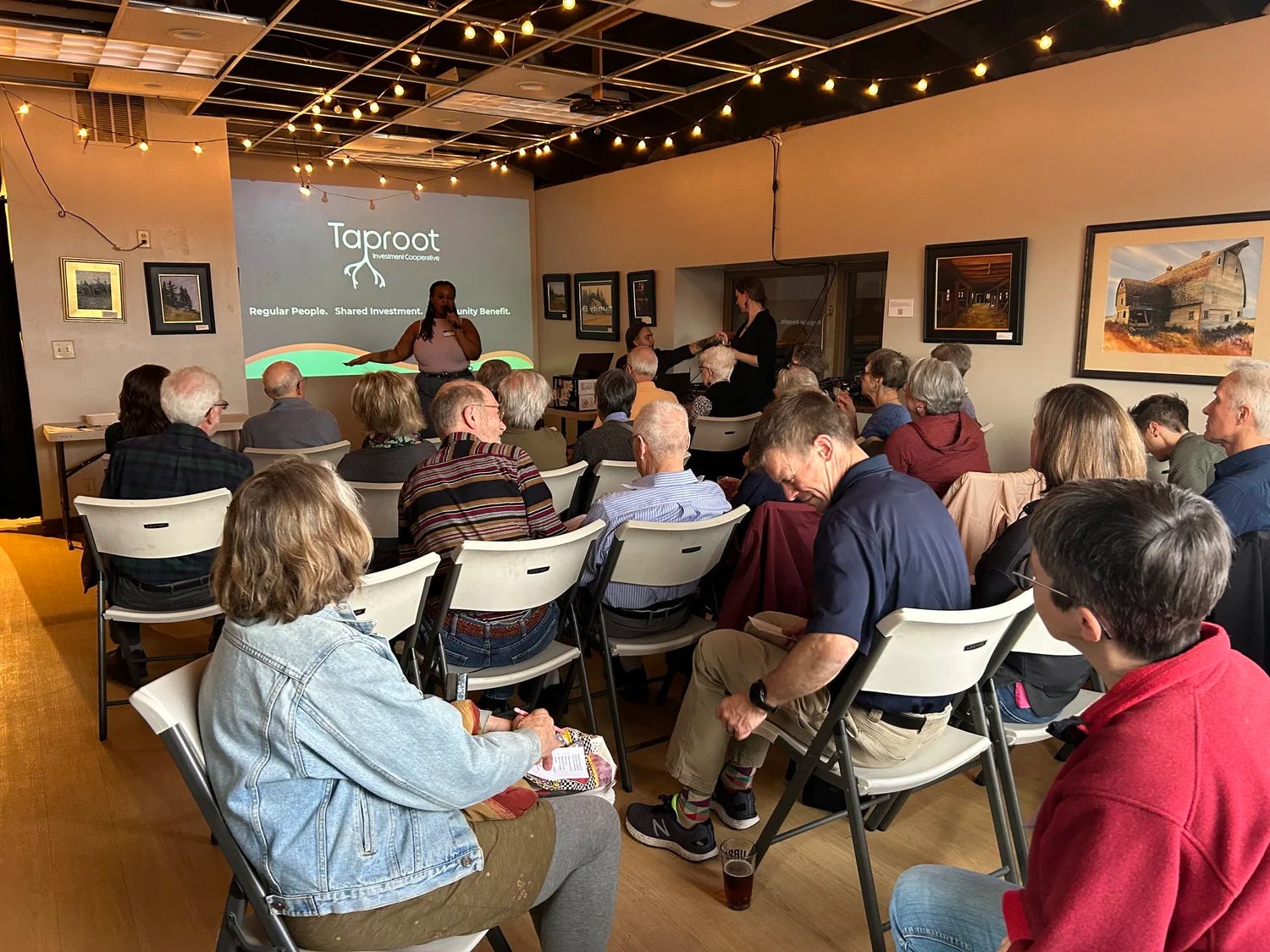
2) Taproot Investment Cooperative in St. Paul’s St. Anthony Park; and
3) South Como Community Investment in St. Paul’s Como neighborhood.
Though facing distinct pressures, all three share a purpose: to stabilize their neighborhoods, preserve cultural fabric, and return economic control to residents. The Community Ownership Learning & Action Lab conducted 67 interviews and site visits across three regions to understand how co‑ops can do just that.
Key patterns emerge across the three cases: relationships function as infrastructure; community capital forces institutions to adapt; and “translation” across mismatched systems is essential to closing deals. Together, these create early‑stage but durable infrastructure for community control of commercial spaces.
Making Mismatched Systems Align
IBWIG is an investment cooperative of West and East African immigrant women small business owners. Its members turned ancestral rotating savings practices (susu/ayuuto) into modern collective finance, pooling about $160,000 through a WhatsApp lending circle during the pandemic.
Lenders initially declined to finance IBWIG’s first three acquisition attempts because the cooperative lacked conventional collateral and a credit history. ACER, the legacy nonprofit that incubated IBWIG, identified Shingle Creek Plaza as a long-term community ownership opportunity and teamed up with IBWIG, bringing its financial track record and institutional credibility into the deal.
In 2023, ACER and IBWIG formed Brooklyn Cultural Village, a joint ownership entity, and purchased Shingle Creek Plaza for $5.2 million. ACER owns one parcel and co‑owns the other with IBWIG; IBWIG holds 49% ownership and a minority voting stake. ACER plans to expand community ownership over time through a long-term stewardship model that gradually shifts ownership to community members. As one ACER leader explained, “We didn’t want to just be another nonprofit owning a building. We always said we want community to really own this.”
Ultimately, IBWIG’s community capital got the project started, while ACER’s reputation and relationships helped make the acquisition possible. What might look like an unusual hybrid ownership model (a nonprofit + an investment co-op) is better understood as a practical solution, one that allowed cooperative governance, conventional lending requirements, and shared ownership to work together after their misalignment had created bottlenecks.
Taproot Investment Cooperative emerged in St. Anthony Park to combat gentrification and preserve community-serving commercial space. Members see themselves as intermediaries between local tenants and local savers, as one founder explained: “People in North St. Anthony have reasons to come to South St. Anthony: they don’t want to see [these businesses] displaced. And so, they’re willing, because they have savings, to invest some of that in something that is trying to help to keep businesses from being displaced.” When a historic school building went up for sale, a Taproot investor bought it in 2024 and Taproot provided a second mortgage for critical updates.
Taproot’s structure mixes a for‑profit cooperative issuing shares under a state exemption, nonprofit partners bringing grants or PRI capital, and participation from community members, tenants, and mission‑aligned investors. Taproot prioritizes values over profit: “It’s values alignment that we really care about rather than, ‘Oh, we’ll get a 4% return on this.’”
South Como Community Investment Cooperative grew from COVID-era neighborliness and block-level conversations: “We’d be hanging out in our front yard, chatting with neighbors. A lot of the conversations ended up going back to, ‘Hey, did you see somebody bought that building? I wonder what they’re going to do with it.’”
When a small mixed-use building came up for sale, neighbors fantasized about buying it but realized, “We don’t have $100,000 sitting around, and we don’t have good credit.” After emailing 25 neighbors to attend a meeting at a neighborhood bar, “fifteen showed up. Seven stayed [as board members] to build the co-op. We each put $20 into a literal hat.”
Realizing commercial‑only purchases were unrealistic, the group pursued a semi-occupied mixed-use building, combining residential rents, commercial leases, and cooperative ownership. This added complexity but made the deal financially viable.
The result was a modest but generative model: small-dollar neighborhood investment; immediate cash flow through rents; and proof that “a first-time shared ownership experience in St. Paul” could pencil out. South Como purchased its first property in November 2025; member investments covered down payment and pre‑development costs, and the Metropolitan Consortium of Community Developers (MCCD) provided a low‑interest shared‑ownership loan.
Community Capital As Leverage For Larger Financing
Community capital reshapes how lenders, CDFIs, philanthropies, and policymakers engage with community ownership.
IBWIG’s internal raise signaled credibility; ACER’s track record brought relationships and opened institutional doors. As one staffer explained, “[IBWIG] had enough down payment, but a cooperative is not a traditional model. Imagine trying to approve or qualify 27 plus people.”
Shared Capital entered after IBWIG had already raised its internal capital. Its role was financial and educational; it helped Sunrise Banks understand cooperative underwriting. Institutional engagement grew from there, including the Minnesota Legislature’s first-ever appropriations bill for the Shingle Creek Plaza acquisition.
The two groups also resisted pressure to route ownership through white‑led intermediaries: “They wanted to use white intermediary organizations to hold the property. We just refused to do that.” Upfront community capital, combined with ACER’s credibility, allowed both organizations to maintain control while navigating a real estate system shaped by racialized barriers.
Aimed at “getting investments out of the stock market and into the local economy,” Taproot’s initial $330,000 raise from about 42 community investors enabled philanthropic engagement (a potential $1.2M PRI that later fell through). When the group realized it couldn’t control outside capital timelines or risk tolerance, Taproot shifted to a second‑mortgage strategy and smaller projects, prioritizing values over scale. Community capital allowed Taproot the autonomy to choose a different path, reducing dependence on outside funders.
South Como also began by mobilizing community investment. Its preferred share offering raised over $100,000 in a week — small investments ($1,000–$5,000) alongside one larger gift — and MCCD provided a 4% loan with patient terms, producing a minimal but viable capital stack. Rather than a conventional lender-borrower relationship, the financing structure with MCCD was developed collaboratively; the deal was, in effect, a shared experiment..
Because South Como already had its own capital base, it avoided rigid grant programs (e.g., St. Paul’s LOCAL Fund) which required vacant properties, excluding most viable opportunities in the neighborhood. They were able to move forward on a deal structure that matched local reality, not external mandates.
‘Translation’ As Dealmaking Capacity
The work of translators — individuals or organizations that liaise between communities and institutions — turn relationships and goodwill into concrete financing and ownership. These bridge-builders help each side understand the other and make it possible to move projects from idea to deal.
In the Twin Cities, translators operate within a supportive environment, including strong intermediary organizations, experienced CDFIs, and a long history of cooperative development in the region. This does not remove the need for translation labor, but it spreads the work across more people and institutions.
At ACER, translation happens through both individuals and the organization itself. ACER acts as a bridge between community voice and institutional decision‑making. “We’ve always made it a practice to provide a bridge for those relationships between systems and community,” said an ACER staffer.
Institutions respond not only to financial metrics, but also to organized groups of people. That’s why ACER’s work is both technical and political. The nonprofit builds power by showing community backing — bringing residents to council meetings, organizing community testimony at the state capitol, and creating visible public participation.
At Taproot, translation is led largely by individuals but grounded in long-term relationships and neighborhood credibility. They translate values in two directions: outwardly to lenders, lawyers, and philanthropic actors who may be unfamiliar with the model, and inwardly to neighbors who need to understand how the model works and why it’s worth participating in.
The demands are still significant. As one member noted, “We don’t have a single staff person.” But Taproot operates within a broader network, including the nonprofit Creative Enterprise Zone (CEZ) and a large, experienced board. The burden is distributed across a team with deep experience, making the work more sustainable than in contexts where one or two individuals carry everything.
South Como is the clearest example of translation concentrated in one individual, especially at the beginning. One founder’s long-standing relationships were critical to launching the co-op. After years of community organizing, she had built connections with “thousands of people” through events and local initiatives. “People know me,” she explained. “I don’t know if some person who hadn’t been really invested in their community could just pop up and be like, ‘Hey, you want to give me $500 to start a co-op?’”
Beyond the cooperative itself, she also builds new institutions when needed — for example, creating a business association because “there’s not a structure for this.” Translators, therefore, both align existing systems and create new entities to fill gaps.
Relationships as Infrastructure in the Twin Cities
Across interviews, the word “relationship” appears almost as often as “ownership.” This is not incidental. Relationships serve as critical infrastructure, performing specific functions that make deals possible.
Nexus Community Partners connected ACER to Shared Capital, which then helped Sunrise Banks lend into a cooperative structure. The East Portland Community Investment Trust provided a model for long-term community ownership, while state legislators helped secure public appropriations for the Shingle Creek acquisition. Together, these relationships created a pathway from grassroots organizing to commercial real estate ownership.
Spelling out how partnerships are built through relationships, not transactions, one staffer said, “Everybody in our team is always going to say relationship, relationship, relationships… because I am rooted in my community. They trust me. You cannot just go into a community and tell them what needs to be done. You have to have a relationship.”
Relational networks are the foundation of economic and political power. ACER’s work, for instance, depends on connections among community members, intermediaries, funders, lenders, consultants, brokers, and elected officials at all levels. Those networks let projects move fast, adapt, and solve problems in real time — filling gaps where formal institutions fall short.
Yet legitimacy in these networks is shaped by race. As one staffer observed: “Even though we’re a minority-majority community, white folks still control a lot of wealth and ownership, and they don’t really want to even sell or transfer that ownership to us.” To gain control over real estate, projects must often become acceptable within a system still underpinned by structural racism. Legitimacy is both about financial credibility and about who is seen as trustworthy within racialized power structures.
Taproot and South Como operate within a similarly interconnected ecosystem. Taproot’s founders describe Creative Enterprise Zone as the starting point: “We were conceived in the CEZ boardroom.” CEZ acted as an incubator, while Nexus Community Partners connected the group to legal support, capital, and peer organizations. And Platform CRE served as both a commercial broker and a mission-aligned advisor embedded in the community ownership ecosystem.
At South Como, one founder captured this ecosystem’s tightness: “If you’ve talked to Taproot, you’ve talked to all my people.” Another added, “We leveraged other people’s information. The road had been paved by Hamline-Midway and Taproot. Nexus and Platform helped push it all into a form that made sense.” MCCD — a long-time player within both the CLT and broader community development fields — helped develop one of its first shared-ownership real estate loans. These relationships reduced uncertainty, accelerated learning, and allowed newer projects to build on pathways that earlier initiatives had already created.
This highlights an important insight: newer projects are able to move faster when they don’t have to reinvent legal structures, financing relationships, and organizational models from scratch — i.e., when they can plug into an ecosystem that lowers the barriers to entry and success.
Why This Matters for Practice
ACER and IBWIG, Taproot, and South Como respond to a deeper structural condition: Community ownership is recognized enough that groups must comply with cooperative statutes, securities laws, underwriting rules, and property regulations. But it’s not recognized enough to provide ready-made models, standard deal structures, or predictable financing pathways.
Each case demonstrates a version of this:
ACER/IBWIG align cooperative democratic governance with lender underwriting requirements and a long-term pathway to community share ownership.
Taproot pairs an investment club model based on mutual participation with securities compliance to preserve community‑serving real estate.
South Como aligns mixed-use property acquisition with cooperative capital pooling and neighborhood-based membership.
Locally pooled capital functions like upfront equity, signaling credibility to lenders and funders, lowering perceived risk, and creating room to experiment. But importantly, community capital depends on local wealth, class composition, income, trust, and existing financial practices. The Shingle Creek case highlights the importance of building on practices already being used by communities (e.g., lending circles) rather than imposing models from outside.
Translation work remains essential because the Twin Cities community ownership field is still developing. Translators rely on long-standing relationships and credibility to make projects legible to institutions, then convert that trust into loans, appropriations, share purchases, grants, and policy openings.
Practice implication: Resource the functions that make shared ownership projects viable — early community organizing, legal technical translation, cooperative securities support, patient capital, and peer learning across projects. Focus less on inventing new models from scratch and more on institutionalizing the pathways these projects have already begun to create.
Bottom Line
With one of the nation’s strongest cooperative traditions and a vibrant ecosystem of mission-driven partners, the Twin Cities has become a national proving ground for community ownership of commercial real estate.
The region’s innovation emerges from the interaction of local politics, rapid adaptation to displacement pressures, and a network of intermediaries, ‘translators,’ and resident investors. These projects are building repeatable pathways — legal forms, pooled capital strategies, lending relationships, and policy openings — that new efforts can plug into.
The recommendations in our companion field note, “Holding Space: How Investment Cooperatives Are Anchoring Stability in the Twin Cities,” are a start toward turning these promising practices into durable, institutionalized infrastructure before the next wave of displacement makes preserving neighborhoods even harder. The evidence of viability is clear in the Twin Cities as across the country, proving that community ownership can become a permanent option — a way to make real estate work for communities rather than around or against them.
For the full analysis and detailed recommendations, check out the COLA Lab’s Community Ownership Field Guide: A Multi‑City Panorama, which compares community ownership projects across U.S. cities. Join the COLA Lab’s mailing list here.

Ahmed Mori is Co-Director of the Community Ownership Learning and Action Lab (COLA Lab) at the University of Miami, where he spearheads the creation of research, tools, and strategies that center tenant and community power through collective ownership and cooperative governance of real estate. He was formerly Vice President of Community Economic Development at Catalyst Miami where he oversaw worker and investment cooperative development. He is a licensed attorney and a doctoral candidate in sociology at Johns Hopkins University, serves on the boards of The Allapattah Collaborative CDC and the Miami Institute for the Social Sciences, and is an alumnus of the Center for Community Investment’s Fulcrum Fellowship in 2024-25 and the Law 4 Black Lives Divest/Invest fellowship in 2019-2020.